Sunday, June 24, 2012

Slaves of Righteousness

I’m impressed with myself—I’ve mostly stayed away from politics throughout this blog! Alas, my friends, I am sorry to report your reprieve is at an end. This week marked the beginning of the Fortnight for Freedom, and the USCCB has asked the faithful to mark a special period of “prayer, study, catechesis and public action.” So, in deference to the Bishops’ request, I duly submit my reflections on Freedom.

Don’t worry. This post is not going to be yet another commentary on the HHS mandate itself.  Plenty of those are floating around nowadays.

Instead, I shall be a good American and talk about Freedom.  Before you get too excited though, I must admit I shall be a bad American and not talk about Freedom © American Founding Fathers, 1776.   Instead, I shall be a good American Catholic and talk about Christian freedom.  One of the beauties of Catholicism is that its perspective is goes back so much further than Locke, Madison, and Montesquieu (yup—a large part of American political thought came from a Frenchman—erm—freedom-man). Scripture is full of freedom-statements such as “The truth shall set you free” and “freed from sin you have become slaves of righteousness.”

Wait a second. Slaves of righteousness?  St. Paul can’t have meant that. We are Free Americans. We sorted out that whole slave thing a century and a half ago.  Men and women have paid in blood for that freedom.  And, honestly, St. Paul, you really need to work on your slogans.  Crying “freedom isn’t free,” and watching crusades to topple genocidal dictators, heartless baby-killers, and liberal governments expecting insurance companies to give Church employees the options of purchasing contraception just seems so much more inspiring than being a “slave to righteousness.”  Whatever that even means.

But there’s the problem.  Wars— traditional or cultural—are fundamentally political, and politics is essentially dehumanizing. It turns real people with complex personal problems into sound-byte-ready issues to rally the base and divide America down the middle.  It’s an extremely powerful pull that has reached even the Church.  Politicians and the media try to make us, as Catholics, decide whether we are liberal or conservative. Democrat or Republican.  Many in the Church fall right in line—e.g. Catholic writer George Weigel, best known for his biography of John Paul II who issued a scathing critique  of the parts of Benedict XVI’s Encyclical “Caritas in Veritate” that might not have fallen in line with the current vogue in Conservative economic values.  But the Church is a collection of people, with human problems. It’s interesting that the Catholics in Iraq weren’t begging for American liberation, but merely for food.

One cannot simply legislate away the thorns God gives us.   Paul is very clear that it is not the law that saves.  He’s referring to Biblical law, and if the written Word of God for His chosen people cannot save us, then anything Congress does can’t possibly, either. “Neither death, nor life, nor angels, nor principalities, nor present things, nor future things, nor powers, nor height, nor depth, nor any creature will be able to separate us from the love of God.”

So certainly, promoting a just society is central to the Catholic mission, and that probably means Bishops will wade into the political ring.  However, Bishops must remember they wade into the political ring as the Vicars of Christ—teachers—and not as the leaders of just another interest group trying to push yet another agenda on the rest of the nation.  Sadly, to many outside and even within the Church, this is how they come across.

During this fortnight for freedom, I urge you to reject the partisan politics that threaten the Church.  I beg the USCCB and all Catholics to look to our history and remember what freedom means to us as not just Americans, but as Catholic Americans.  Freedom means something so much more beautiful than restricting elected officials.  It means being free from the yoke of sin.  And so I urge you to take this fortnight to not only reflect on Christian freedom, but do something freed from sin—something righteous.  For it is only in losing our lives will we gain it, and only in being slaves to righteousness shall we be truly free.

Sunday, June 17, 2012

Veritas in Caritate

Last week, I saw Ironman, and it confirmed to me that when it comes to seeing pain, I’m a wimp.  It’s not that I don’t have an acceptable pain tolerance myself, but throw up an image of someone getting the magnet that was keeping shrapnel from piercing his heart ripped out of his chest, and you can pretty much bet you will find me with my eyes closed and my hands reaching longingly for the mute button.

The Immaculate Heart of Mary
This is not all that abnormal. Many people hate seeing others in pain—some have even not been desensitized to it.  But, fear not, this is not another Catholic jeremiad bemoaning the moral decline of our society.  See, I seem to be an abnormality with my reaction to others’ pain.  But the anomaly goes deeper than that.  I’m not only uncomfortable about people being hurt physically, but also when they’re hurt spiritually.

You might ask what this means.  Well, as a Catholic, I believe in a soul.  I also believe in this pesky little thing called “objective morality,” which basically means that every time you do something wrong, you are tearing your soul kicking and screaming further from God.  And that’s no better for the soul than Tony Stark‘s chest magnet being ripped out is for his heart.

In practice, that means that watching my friends do something morally wrong is the spiritual equivalent of watching them cut themselves.  No wonder I get so uncomfortable at frat parties.

Of course, when someone’s cutting himself, the proper response isn’t to threaten him with the fires of Hell.  It’s not the time to lecture him about the sanctity of the body, and how God is angered by the desecration of His temple. The person who cuts himself is broken, and in need of healing, and so the proper response is love.  And love is not driven by fear, but is patient and kind.  And it’s love that conquers all.  Sure, at some point the “that wasn’t okay” conversation should probably happen, and this can serve an important point for accountability.  However, having that conversation at the wrong point in time not only doesn’t help, but can undo progress that had been made.   

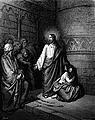
Jesus and the Woman Taken in Adultery
Gustave Doré 
So me striding into Shooters during alumni weekend with a sign announcing, “Hell awaits you! Repent!” is probably not quite the Christian way.  Sure, the Catholic who goes to a frat party and sees some of the partygoers taking a knife to their soul perhaps should feel uncomfortable about it, just as we all feel uncomfortable about self-mutilation.  However, the to inflate ourselves and self-righteously condemn so we can distance ourselves from the messiness that comes with sitting at table with sinners breaks Jesus’ examples just as the sins they themselves commit.

After all, many of those same partygoers simply disagree with Catholic morality. Some have even thought much deeper about it than the Catholics who want to condemn them have.  I personally find getting drunk to be probably morally questionable, and I find a faithful homosexual relation to be probably not.  Many Catholics probably disagree with me on one or both counts.  But I promise you screaming Leviticus 18:22 at me will change my mind no more than me going to LDOC yelling about Ephesians 5:18 would stop the Catholics there.  I’ve thought quite deeply about these issues, and if your first response is to tell me which are my sins rather than finding the Christ within me, perhaps your priorities are misplaced.  

Once we have a mutual understanding in love, which bears all things and endures all things, then we can work to find the truth.

Sunday, June 10, 2012

“And we must unite inside her, or we'll crumble from within.”


(Spoiler alert: if you have neither read the Harry Potter series nor seen the movies, please immediately remedy that, and then come back and read this post.)

When I first got the news, I’ll admit I was a bit unsure of how to take it.  I had gone onto Pottermore, taken a JK Rowling-approved house-sorting quiz, and the results came up Slytherin. 

Sure, it seems utterly superfluous, but still—if only there had been a real sorting hat!  I could have pulled a Potter and begged, “Anything but Slytherin, anything but Slytherin!” The hat would have hemmed and hawed and said, “Well, if you’re sure, better be GRIFFYNDOR!”  and all of you would have been so proud to be friends with me.  After all, choosing not to be a Slytherin is a Potter-endorsed way to show how we carefully gather all the information and give others the benefit of the doubt before passing judgment.

Wait—he begged not to be in Slytherin based on a single rumor he heard from a person he just met? 

Oh. 

Well if Potter neglected to charitably portray his rival house throughout his story, allow a new member of the House try to rectify matters.

The Ravenclaw Eagle
The way I understand it, each house is characterized by certain traits.  Ravenclaw is marked by intelligence and ambition.  If we Catholicize Ravenclaw, I think St. Thomas Aquinas would have found his home here. This Dominican Scholastic theologian was dedicated to reasoning his way to uncovering the mysteries of God, and attempted a summation and defense of all the Church’s teaching in his never-completed Summa Theologica.

The Hufflepuff Badger

Hufflepuff is marked by compassion and loyalty, and I think that if she found herself in Potter’s world, Mother Theresa would have joined this one.  The tiny nun dedicated her life to service of the poor and emptied herself past the point it hurt in service to them, even when no longer feeling the comfort of Christ’s immediate presence.

The Gryffindor Lion
 It’s no mistake I said the hat would have sorted me into Gryffindor if I had permitted myself a snap judgment against my house.  When I finished 8th grade, one of my artistically-inclined best friends drew each of our friend group a fantastical creature (we are admitted fantasy-addicts).  For me, she chose a Griffin: partially characterizing it in her letter of explanation as “brave, stubborn, compassionate, and obsessed with truth to a fault [i.e. idealistic].”  I think St. Joan of Arc was a Gryffindor at heart.  A peasant from Domrémy, she takes directions she hears from Sts. Michael, Margaret, and Catherine all the way to the French prince, convincing him to give her an army and eventually breaking the English siege of Orléans in her conspicuous white armor—persevering in her beliefs even through being burned at the stake for heresy after being captured.  

The Slytherin Snake
Slytherin is complex, and you probably have a knee-jerk reaction to hate and fear it, so bear with me while I give my house a bit of discussion. My admittance letter from Prefect Gemma Farley focused on how fiercely loyal Slytherins are to each other.  And of course they’re ambitious, but that means they’re reaching for some ideal.  It must be admitted Slytherins don’t always choose the best ideals—in the case of Tom Riddle it was power and eternal life.  However, Salazar Slytherin sought the seeds of greatness in his students, and there are many ways to be great—those that are holy, and those that aren’t.

I think most all of us at Duke have ambition.  Otherwise, instead of selfishly taking up all of our time working for good grades and doing all the extracurriculars and SATs, SAT II’s, etc. in high school, we’d have been in soup kitchens actually helping people.  And, sure ambition out of hand can easily lead to Voldemorts, but that’s why which why the Church gives us the litany of humility: perhaps the most important  and difficult prayer for any student at Duke.  But ambition isn’t intrinsically prideful or against God, so long as we keep in mind what Sam Wells had to say in my first blog post. Would it be wrong to have the ambition to become a saint—something we’re all called to do.

I think St. Ignatius would be a Slytherin (and his Feast day is conveniently on my—and Potter’s and Longbottom’s—birthday). His Autobiography tells us how he was from an aristocratic family who read of Jesus and the saints when convalescing from a war injury, which transformed his ambitions from having a glorious military career and successfully wooing a pretty lady to doing great deeds for God.  He transformed this ambition ad majorem Dei gloriam to the Order he founded: the Society of Jesus (Jesuits), who, with their fourth vow of obedience to the Pope (i.e. House loyalty), spread throughout the world.  It eventually became so influential that the threatened monarchs of Europe pressured the Pope to have the Order suppressed, though even this did not last forever.

All four paradigms represented by Ravenclaw, Hufflepuff, Gryfindor, and Slytherin have their place in the Church–each has its representative saint, after all.  However, each paradigm has its own pitfalls—after all, even Peter “was given a thorn in [his] flesh.”   Individual service is necessary, but as the Church’s social teachings instruct us—ministering to the poor without also planning for institutional change will leave the poor with plenty of warm fuzzies, but those that will fade with the dawn of a new day and the return of the same problems.  The Summa is perhaps one of the greatest single intellectual masterpieces of all of Christendom...that almost no one bothers to read anymore, and which most Catholics would have trouble applying to their life.  Fighting for the Church has been blessed by Popes for millennia, but without exploring the wider consequences of war and without careful considerations of all sides of the issue, we have the Crusades.  And what can go wrong with ambition dedicated to an ideal within an environment of loyalty and obedience, if it is untempered by love and compassion?  Why, welcome, most esteemed High Inquisitor.

It takes all types to make a Church.  We are all one Body, and each one of us complements the others in serving Christ our head.  In doing this, we must remember last words of the sorting hat we hear in the series, as he finishes describing the differences of the houses:

And we must unite inside her,
or we'll crumble from within.”

For, “the whole body, being fitted together and held together by what every joint supplies causes the growth of the body for building up of itself in love” (Ephesians 4:16).


Sunday, June 3, 2012

A Temple of the Lord


I spent last week eating healthfully and going to the gym.  Your first reaction is probably an approving, “Good for you, Shane!”  And indeed, heaven knows I need to work on my health, since every academic year I seem to do my best to drown my body’s best efforts at longevity in excessive caffeine, sugar, sedentariness, and sleep deprivation.  If our bodies are a temple of the Lord, I have been damned a thousand times over for its wanton desecration. 

But, I’ll be honest: last week’s veggies and gym sessions weren’t peace offerings to assuage my wronged God.  And as few calories as I was eating and as many hours as I was spending in the gym, it’s a bit excessive to try to spin it as “being healthy.”  And it’s not like I particularly need physical strength—few of us do: athletes, military/intelligence personnel, and those in some labor intensive industries such as construction.   So why would I care so much? 

If I’m honest with myself, I can only conclude I had an extremely simple reason—I wanted to be more attractive.  This is absolutely normal, right?  How many guy want to bulk up?  How many girls want to slim down?  And it makes sense, considering that despite disputed efficacy, the body-building supplement industry was worth $2.7 billion in 2008, and the diet industry was worth a whopping $60 billion in 2011.  And our popular media agrees: Stephanie Meyers seems to excuse Edward Cullen for his rather obsessive stalking with frequent reference to his “marble Adonis” body.  But, again, this is absolutely normal, right?   I just watched Thor—what guy doesn’t want a body like Chris Hemsworth?

Probably Christ for one. The Bible talks about many aspects of His life and death—but it seems remarkably thin on Jesus’ workout regimens.  In His years preaching on Earth, God somehow didn’t see fit to mention, “Blessed are the hot.”

So why do we strive so much to have a “hot body”?  I don’t need it for my career; I don’t need it to be healthy.  Well, what is “being hot”?  It seems to be generally a measure of how much you can make another person “want” you merely upon looking at you.  When Jesus warns, “everyone who looks at a woman with lust has already committed adultery with her in his heart?”  (Matthew 5:27) he is speaking about this exact thing we are attempting to evoke with our workout regimens and protein supplements.
If we actually succeed in this, we are literally leading those around us to sin.  Sure, it fans our ego to have all the girls or boys talking about us, and perhaps we can’t help but wonder if anyone would date is if we’re not attractive enough.  But if we accomplish in making all those who look at us covet us, we have converted our body into a temple to ourselves, not a temple to the Lord.

This is not to say we should never work out or eat healthfully: being healthy, staying fit, making sure we’re able to do what is required of us are all deeply ingrained in the Catholic Tradition.  From the very beginning of religious orders, the Benedictines have divided each day into care for the body, mind, and soul, and the Jesuits have always discussed cura personalis—care for the whole person.  But we must be careful not to go too far, or act in an immodest way (why did you just take your shirt off in front of all those people?  And what exactly is the purpose of that plunging neckline?).

After all, for all the care we can spend sculpting our bodies for possible human lovers, how many of us spend that same amount of time sculpting our soul for God?  The Church teaches that our bodies are sacramental; what we do with themand whyhave eternal reverberations in our soul. 

Honestly, my reckless disregard for my physical health during the school year is against my faith.  I’m not Jesus; when I destroy my temple, it takes more than 3 days for to rebuild it.  But with the modern world telling us we’ll never have a boyfriend or girlfriend unless we have a certain body, it is so easy to fall prey to the other extreme, and allow our bodies to become idols.

Or perhaps it’s not just society.  Perhaps we fear, deep down, we’re the ones who are shallow.  If we have the right body, we’ll probably end up having our pick of physically attractive partners, and we'll never have to stop and reflect that we don't look with heaven’s eyes and see the whole person, but merely life on the surface.

Because above all, if love is skin-deep, then true covenantal marriage is impossible, and if we cannot overcome desire to possess others’ bodies, then even our closest relationship with our spouse will be tainted with sin.

Sunday, May 27, 2012

Only Hope


            There’s a song that’s inside of my soul
            It’s the one that I’ve tried to write over and over again.


This week, I have been discovering the depths of my pack-rattedness while I do a post-graduation clean out my room.  My collection of classical recital programs and ballroom dance club membership cards shall make some historian 500 years from now extremely happy (students shall think that my life is typical!  It shall be God’s practical joke on turn of the millennium American pop “culture.)  While cleaning the shrine to dead—erm—immortal arts that is my room, I found one of my favorite songs I’ve accompanied: “Only Hope,” made famous by Mandy Moore in the movie A Walk to Remember.  

            I’m awake in the infinite cold,
            But You sing to me over and over again.

Summers after each year of Duke have been marked by the same thing: loneliness.  Sure, I’m remarkably close with my High School friends—but they’re not always around.  And if I’m totally honest, even when surrounded by the love of the friendships I’ve made at Duke, or when I see my Chicago friends who are like a second family to me, I can still feel alone.  As thankless and undeserving as it makes me feel, there are times that even my closest friends somehow just aren’t enough.

            So I lay my head back down,
            And I lift my hands and pray


“Lord, ‘It is not good that man be alone.’   My God, please let me have a  boyfriend—or even just a date.”

            To be only Yours, I pray
            To be only Yours.

“Don’t You see it, my Lord?  If I could just have a guy to call my own, it would fix everything—loneliness, self-esteem. All I need is a boyfriend; then, I’d be happy.”

            I know now You’re my only hope. 

Shortly after that prayer, I would go to some Catholic event and see Fr. Mike in his habit, and I couldn’t fight the shame that would come.  After all, a boyfriend doesn’t fix loneliness.  My campus minister once told me how people, even after they are happily married, still feel loneliness.

            Sing to me the song of the stars,
            Of Your galaxy dancing and laughing and laughing again.

And He will raise you up on eagles' wings.
See, this song didn’t start out as a romantic ballad, as Mandy Moore’s cover would have it appear. It started out as a Switchfoot song—a love song, yes, but a love song to the God who made the Earth to the chorus of the song of the stars (Job 38:7). A responsorial that overflows to the God who inspires joy, dancing, and laughter in the galaxy of His creation.  In the words of G. K. Chesterton, “A characteristic of the great saints is their levity.  Angels can fly because they take themselves lightly.”

            When it feels like my dreams are so far,
            Sing to me of the plans that You have for me over again.
           
When we turn towards ourselves, how can we see anything but the beauty and love that it took to create us?  Isn’t all we need to complete us God alone? Or are we so blinded by our own griefs and desires that we do not see the hand that holds us?  Or have we learned to hate ourselves so much that when we are held in the palm of His hands, we see sinners in the hands of an angry God, moving swiftly towards the fires of Hell?  If God is merely a promise of Hell, no wonder we seek refuge in other people.  We may be fallen and broken, but being fallen and broken doesn’t stop His love for us—why should it stop our own?  Even when we strike out alone from the path he created for us, He finds His lost sheep, and guides us another way that will lead to the gates of heaven. 
           
            And I lay my head back down,
            And I lift my hands and pray

“How, oh Lord, how can we be lonely when You wrote Yourself into every one of Your creations?  How can we feel unloved when You have given us everything.”

            To be only Yours, I pray
            To be only Yours.

“Lord, whenever I blind myself to the truth and start to feel lonely, reveal Your face in everything around me—Your hand guiding every move I make.”

            I know now You’re my only hope.

Loneliness requires both an acute awareness of the self and a feeling of separation of that self from its surroundings.  But that “I” only exists through the incessant tending of God, and He knows me more perfectly than I know myself.  Perhaps loneliness comes from forgetting Plato’s immortal instruction: “Know thyself.” After all, God is in me, so if I know myself well enough, I must know Him. 

            I give you my apathy,
            I’m giving You all of me.

Loneliness might be distinct from apathy; loneliness is reaching for someone who’s not there, while apathy is never bothering to reach in the first place.  But both result in a void.  Sometimes, that void drives us to reach for God—and that’s good.  But still, though I may have misused it in my first prayer earlier, it is still written, “It is not good that man be alone.”  And what we need, God provides, if not always in the way we ask.


            I want Your symphony.
            Singing in all that I am. 

God is never alone—He is the perfect union of Father and Son from which proceeds the Holy Spirit—if we have one, we have all three.  But more than that, Christ is the head of an entire Body.  That the Eucharist is the Body of Christ has the dual meaning of it being the flesh of Christ and the communion of saints.  Being in Communion means we are never alone: each Mass is a play-date with Christ. Each Mass is a play-date with every Catholic who has ever lived.  Perhaps I didn’t see you today, but if you went to Mass and received the Eucharist, I did something better—I saw you in the Eucharist.

            At the top of my lungs,
            I’m giving it back

And, as Gaudium et Spes says, we are only complete “through a sincere gift of self” (25).  No wonder at Duke I felt least lonely, and most a member of the Body of Christ, when giving back.   It is lack of service that makes me feel incomplete—not lack of a particular person.

            And I lay my head back down,
            And I lift my hands and pray 

“My God, thank you for the precious gift of your Body and the community of the faithful.  However far we all may be, I am with people I never even new existed.
            
           To be only Yours, I pray 
           to be only Yours. 

“True loneliness, I know, would only be separation from You, for

           I know now You're my only hope."


Sunday, May 20, 2012

Who is Like Unto God?


One week ago today, I stood in the Wallace Wade football stadium surrounded by almost 5,000 other Duke students.  After being called “intellectually sparkling” and “completely cool” by the Dean of Trinity School of Arts and Sciences in a parting blow in the competition between Trinity and the Pratt School of Engineering, President Brodhead pronounced the ceremonial words that officially designated me a graduate of Duke University. After a fleeting question as to why I hadn’t listed philosophy as my first major instead of economics—I could have had a BA degree rather than one that’s just BS—I realized that I was officially done with Duke.  Ready or not, my undergraduate career was over and it was time to embark on a new adventure at law school.  Of course, first there’s the summer after undergrad—a nostalgic time when we drudge up memories and piece them together into “life lessons” we use to justify the fact that all that knowledge we paid for night after night in the library is rapidly receding from our heads.  This is the first of those nostalgic moments.
A traditional picture of St. Michael defeating the Serpent.


When I received the sacrament of Reconciliation my Junior year in High School, most Catholics take on the name of a saint as a Confirmation name.  Because “Shane” is notably absent from the list of the canonized, I chose “Michael,” after St. Michael the Archangel.  St. Michael is best known as the general of the heavenly host—foretold in Revelation to defeat Satan and throw him into the fiery lake. That I chose a fighter comes as no surprise—fighting comes so much more naturally to me than Benedictine contemplation (as the students in my House Course who had to try to convince me to join the Benedictine order rapidly discovered).  I spent this past year fighting DSG in an attempt to allow religious student groups the freedom to determine their own organizational structure, excessive alcohol use in my Fraternity, and that “Catholic” and “LGBT” are not contradictory on the Blue Devils United blog.  Perhaps I should have taken St. Jude as my confirmation name.
However, a lecture I received on my last full day as a Duke undergrad made me reconsider what it means to have Michael as my namesake.  The outgoing Dean of the Chapel, Samuel Wells, gave this sermon at the Baccalaureate service for graduating Dukies.  I highly recommend that every single person stops reading this blog and go listen to it; you will get so much more out of Dean Wells than anything I could possibly write.
His sermon made me take another look at my Confirmation name.  See, “Michael” means something very particular—“Who is like unto God?”  For all the fact that he is the leader of the army of God himself—actually tasked with defeating evil—his name is not a holy warrior’s name. There is no “The Great” attached to it that is the signatory title of conquerors (eg Alexander, Saladin, Catherine).  Instead, he is, at his very essence, humility.  “Who is like unto God?”
I can hear your reaction now, “Christian humility?  How innovative!  How world-changing! $200,000 and a guy in a fancy red robe and you tell us that Christians are supposed to be humble?  We’ve never heard that one before.”  Yes, we Christians bandy around the term “humility” quite liberally, but in practice it often means demurring when someone complements you.  I’m guilty of this; I’ll admit I am horrible at taking complements. However, Dean Wells’ sermon presents another way to look at humility: rather than trying to solve others’ problems, we should be present with them through their problems.  In this Dean Wells introduced an alternative Christian—or even human—vocation that is countercultural to the one that we are taught to internalize at school.  Directly after Dean Wells spoke, President Brodhead rose and gave the Presidential Commissioning to the graduating class:  essentially, “we gave you the tools, now fix the world.”
Being with people may not seem like humility at first.  But, consider what it means to “be present with another.” Well first, you must first be.  When we merely “be,” we are as God sees us—stripped of our resumes, grades, or any other past accomplishments.  God said, “I am who I am,” not, “I am what I do.”  But that’s really scary to us, because to be who we are is to be broken—fallen.  God sees me as I actually am, and sometimes that’s not a Shane I like to be reminded of.
Next, you must be present.  Not in that embarrassing moment when you went up to hug that person on the quad you swore was someone else (should have listened to Matthew 5:34).  Not in that test you have in three days.  Not three dorms over where your latest crush is.  You simply trust in God, and do as do the birds in the sky and the wild flowers in the field.
Finally, you must do all of this with another.  Now, if you’re anything like me, being truly present with myself is hard enough. Remember the lack of Benedictine contemplation?  To let someone see my entire self: shame and fears along with the joy, to let them see how utterly dependent I am on God (while stubbornly trying not to be), is truly a humbling experience.  It makes hollow even the deepest lies we refuse to let go of ourselves and as the truth sets us free, we participate in the Body of Christ.  For even our deepest secret is not our own—“So we, though many, are one body in Christ and individually parts of one another ( Romans 12:5 ).
But isn’t the above so antithetical to the standard Duke student?  To the effortless perfection we’re supposed to exemplify?  I think back to my Duke experience, and so much of it was finding a problem (/position), setting out to solve it (/applying for the position), and finally duly noting it on my resume, of course glossing over the not-quite-so-successful parts.  However, what were the truly powerful moments? Were they the exhilarations of triumph, when I won a fight? When I got the job?  Or was it when I stopped trying to “fix” my friends’ problem, descended to Earth, and spent time truly with them—in communion with them? 
Few of us will ever have a divine intervention where St. Michael appears wreathed in heavenly light, and, with his flaming sword laws low our clearly Hell-sent competitor (as nice as that might seem in my all-too-frequent less-holy moments).   In fact, most of us will never experience St. Michael in his vocation as heavenly general at all.  But each of us will meet St. Michael.  Perhaps as is fitting for a commander of armies, St. Michael is also the angel of death.  He will be with us as we leave behind all of the comforts we find in this world—friends, loved ones, Diet Coke—as we go on to the next.  In that moment, he can’t protect us anymore, or fix our problems—our battle will be over and our names either in the Book of Life, or not.  But he will be with us as we go face to face with Christ: God’s present to the end.
Take a moment and think about this, the general of God’s army—an archangel whose responsibilities include carrying out the final destruction of evil—will take time to be present with each one of us before we face judgment.  I can’t even find time for family when my greatest battle is a paper for the next day.  I only hope that I will live up to my confirmation namesake, and, even as I fight the battles that are no doubt in my future, remember that it is love that saves, and it is only in å gift of self that that we humans truly find ourselves. 
A gift of self that can only be truly genuine when it is completed with the cry, “who is like unto God?”